
Coinbase Put Apple, Nvidia, Meta, and Alphabet on Base. The Tokens Aren't the Story.
Subscribe Free. The weekly briefing is free, always.
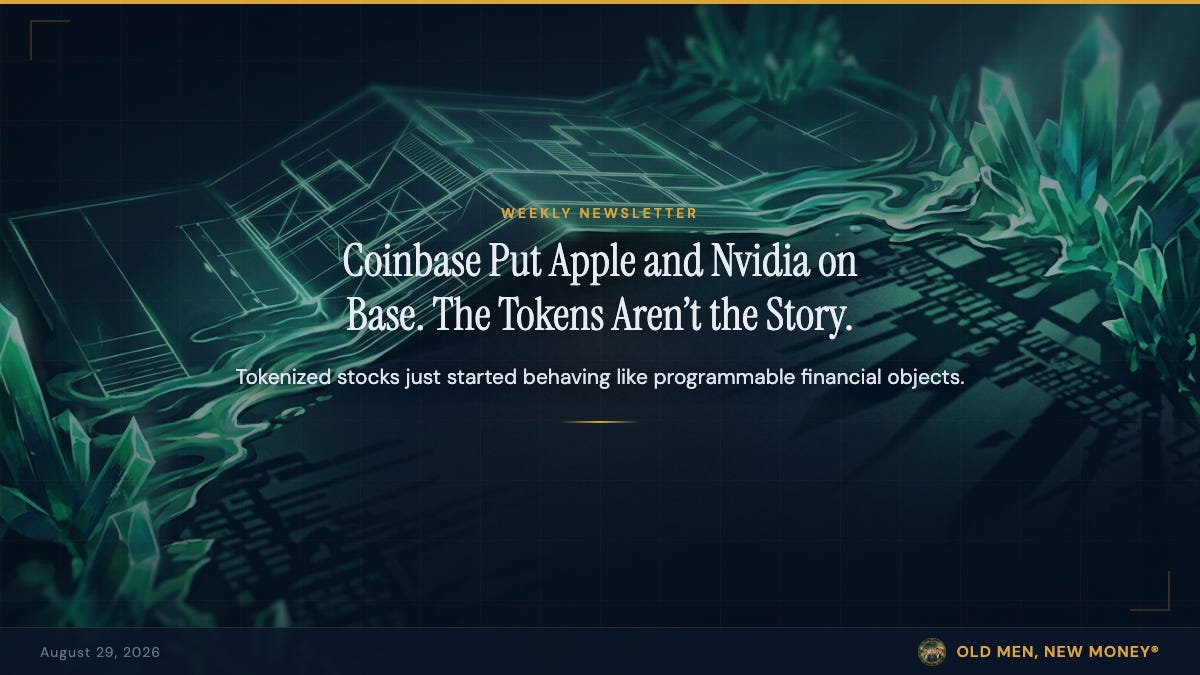
A tokenized stock stopped being a picture of a share and started behaving like a blockchain asset — with an Abu Dhabi trust underneath it, an oracle that turns dividends into arithmetic, and a lending market switched on before the opening bell.
What Actually Shipped
On August 24, 2026, Coinbase launched tokenized versions of four US stocks — Apple, Nvidia, Meta, and Alphabet — natively on Base, its layer-2 blockchain. The tokens trade as AAPLc, NVDAc, METAc, and GOOGLc under the B20 standard, Base’s ERC-20-compatible token format that went live on mainnet in July. Each token is issued against a real share held in segregated, bankruptcy-remote custody. Coinbase says more tickers follow, eventually thousands.
This isn’t a pilot. Per DEX Screener and BaseScan data cited at the time, day one saw roughly $4.55 million of tokens minted, about $3.06 million of liquidity seeded across decentralized exchange pairs, and $10.8 million of trading volume. Aerodrome, the largest DEX on Base, held the deepest pool for all four tokens; the NVDAc pool alone drew about $957,000.
Those are small numbers by Wall Street standards. They are not the point. The point is what was already plugged in on the first morning.
This Was Orchestrated, and That’s the Real Tell
It would be an easy and flattering story to say that a spontaneous ecosystem formed around these tokens inside a week. That is not what happened, and the truth is more useful.
Nine DeFi protocols were live with tokenized-stock support on day one: Aerodrome for spot liquidity; Aave, Morpho, and Euler for lending and borrowing; 0x, 1inch, KyberSwap, and CoW Swap for routing and execution; Wasabi for perpetuals and options. The Defiant counted roughly fifty apps supporting the tokens at launch. The following day, Bitwise announced three model portfolios built on the tokens, with Coinbase and Glider named as partners in the press release. Two days after launch, carry-trade vaults appeared from 628 Labs, Superform, IPOR, and Portals, letting holders borrow stablecoins against tokenized equity collateral.
None of that was an accident. Coinbase didn’t launch a token and wait to see what grew. It launched a financial stack and threw the switch on all of it at once.
Recognize that for what it is, because it cuts both ways. Launch-week integration counts are a distribution strategy, not evidence of organic demand — and anyone who has watched a product launch with fifty logos on the partner slide knows how little that can mean. But it is also the more consequential fact about this week. Assembling custody, issuance, pricing, lending, routing, derivatives, and portfolio management into a single simultaneous launch is a claim that the whole stack is ready. That’s a much larger bet than shipping four tokens.
The falsifiable version comes later, and we’ll get to it: what do teams with no relationship to Coinbase build on this in six months?
Two Very Different Ways to “Own” a Tokenized Apple Share
Here’s the part most coverage glossed over, and the part that matters most to anyone who has spent a career thinking about counterparty risk.
The tokens are issued by Coinbase Onchain SPV Ltd., a special purpose vehicle Coinbase established in June under the Abu Dhabi Global Market framework. ADGM’s Financial Services Regulatory Authority approved the prospectus for the Apple certificates in early August, and on August 11 granted Coinbase permission to arrange investment deals and provide custody for tokenized securities. The underlying shares are held by Alpaca Securities, a regulated broker-custodian, in a bankruptcy-remote structure, and the deposited shares are held in trust for tokenholders. Subject to those trust arrangements holding up under ADGM law, the shares would not form part of the issuer’s estate in an insolvency.
What you hold is a beneficial interest in a real share. That is not the same as holding Apple registered in your own name at a broker — a legal structure sits between you and the stock, and it is only ever as good as the law governing it and the drafting behind it. But it is a categorically different animal from the alternative.
The alternative, used by several competing tokenized-equity products, is a structured note. There, the token is a debt claim: you are a creditor of the issuer, not a beneficial owner of a share. If the issuer fails, you queue up with the other creditors.
Beneficial owner versus creditor. That distinction has been the whole ballgame in structured products for forty years, and it has just arrived in tokenized equities wearing a ticker symbol. If you take one thing from this launch, take the habit of asking which one you’re buying.
Why Earlier Attempts Were Harder Than They Looked
Tokenized stocks aren’t new. They’ve existed in various forms since 2018. FTX offered them. Binance tried. A dozen smaller platforms launched equity tokens of one kind or another.
They didn’t all fail the same way, and the differences are the lesson.
Some were synthetic — the token tracked a price through a swap or contract-for-difference and never touched a share. Easy to launch, impossible to regulate, and holders learned what “unregistered security” means when exchanges pulled the products out from under them.
Others held real shares but kept them in a walled garden. You could trade the token on the issuer’s venue. You couldn’t post it as collateral elsewhere, move it to your own wallet, or compose it with anything. It was a database entry wearing a blockchain costume.
Others hit a third wall: no standardized price data a lending protocol could responsibly underwrite against.
What’s unusual about Coinbase’s launch isn’t any single element. It’s the combination: real shares in regulated custody, a beneficial-ownership structure, native issuance on a public chain, and pricing infrastructure that DeFi protocols already trust. Three years of attempts managed two of those at a time.
Why This Is Harder Than the Treasury Token Wave
Tokenized Treasuries have crossed $10 billion onchain. Franklin Templeton’s BENJI runs across multiple public blockchains. BlackRock’s BUIDL is a multi-billion-dollar fund. Every major asset manager has a tokenized money market product now.
But Treasuries are boring — and we mean that as a compliment to whoever tokenized them first. Their prices move plenty. Their operational lifecycle barely does. A Treasury pays a coupon and matures. That’s the whole plot.
Equities have corporate actions: dividends, splits, spin-offs, mergers, tender offers. They have market makers who hedge in real time and prime brokers who lend them for short sales. Tokenizing an equity means tokenizing the operational plumbing of the capital markets, not just the settlement rail.
So look at how this launch actually solved that, because it’s the most elegant thing in the whole story.
The Oracle Turns Corporate Actions Into Arithmetic
Chainlink price feeds for all four tokens went live alongside the launch — not weeks later, because they’re the critical path. Without trusted, standardized pricing, tokenized stocks are just tokens you can hold and send. It becomes very difficult for a lending protocol to safely accept them as collateral, hard to build derivatives on them, impractical to automate strategies against them. You can design collateral systems without Chainlink. What Chainlink supplies is pricing that dozens of protocols already underwrite billions against, which is why nine of them were ready on day one.
But the feeds don’t just publish the price of Apple. Per Chainlink’s own documentation, the value of each token is:
Token Price = Underlying Equity Market Price × Multiplier
That multiplier is the interesting object. It’s read from Coinbase’s onchain oracle registry on Base, and it represents how many underlying shares each token is entitled to after adjustments. It starts at 1.00.
Now watch what happens to a dividend. Rather than paying cash to holders, the cash dividend is converted into shares and the multiplier rises — 1.00 becomes 1.02, and your one token is now redeemable for 1.02 shares. A 10-for-1 stock split moves the multiplier from 1.0 to 10.0. During a corporate action, Coinbase pauses the oracle through the registry so nothing trades on stale pricing, then resumes once positions reconcile.
The messiest, most labor-intensive part of equity ownership — the part that employs entire departments at every custodian on earth — got compressed into a single number that a smart contract can read in one call.
It also means “backed 1:1” is precise only at issuance. Over time these tokens quietly accrete shares instead of paying you cash. That’s a meaningful difference for anyone modeling after-tax returns, and nobody’s newsletter is going to explain your tax treatment for you.
One caution worth keeping: the feeds are configured as 24/5 — regular, pre-market, post-market, and overnight sessions. Outside those windows the feed holds the last close while the contract remains callable, which is exactly the condition that has liquidated people on other chains. Chainlink tells integrators to implement staleness checks. Whether every protocol accepting these as collateral has done so is not something you should assume.
Still, note what the 24/5 window means in practice. The New York Stock Exchange is open six and a half hours a day, five days a week. When material news hits after the bell, conventional participants stare at futures. Aerodrome’s pools ran through the launch weekend and traders saw real price discovery in tokenized Nvidia heading into earnings — outside any hours the stock market keeps.
These tokens transfer onchain around the clock, without the traditional brokerage settlement workflow. That isn’t the same as saying the underlying equity settles instantly, and it’s more interesting than that. The token and the share now run on two different clocks, and the token’s clock doesn’t stop.
The Manager Sells Intellectual Property, Not Custody
On August 25, Bitwise launched three Automated Token Portfolios: Mag7X (the Magnificent 7 plus SpaceX, equal-weighted), Robotics, and AI Leaders. They’re published, rules-based models designed by Bitwise, carrying a 0.15% methodology access fee, available to qualified investors outside the US.
The mechanism is the story. Glider rebalances your holdings to match the Bitwise model without ever taking control of your assets. The tokens never leave your non-custodial wallet. Bitwise CIO Matt Hougan put it about as well as it can be put: the assets stay in your wallet, and the model comes to you.
That inverts a century of asset management architecture. The deal has always been: surrender your assets to a manager, and the manager runs the strategy on them. Here the strategy travels to the assets. The manager sells intellectual property, not custody.
Which is the thesis of this entire week. Tokenized stocks are starting to behave like blockchain primitives rather than blockchain representations of brokerage assets. A brokerage representation is a picture of your position. A primitive is something other software can act on without asking permission. Coinbase issues, Base executes, Chainlink prices, lending markets collateralize, Bitwise supplies the model, Glider executes it in your own wallet — and no layer in that stack had to negotiate with the layer below it.
What It Means for You
The securities are offered to eligible investors outside the United States under Regulation S and have not been registered under the US Securities Act. US persons cannot buy them. The Bitwise portfolios carry the same restriction.
If you’re an eligible non-US investor, this is another route to economic exposure to US equities without a conventional brokerage account. Kraken’s xStocks on Solana got there first, and others will follow. What’s new is the combination: beneficial ownership rather than a creditor claim, native issuance on a public chain, and composability that was live on the first morning.
If you’re a DeFi builder, you now have institutionally-maintained equity price feeds on a public chain with corporate actions handled upstream in a single integer. Lending markets, options vaults, structured products, basis trades against the listed stock — the surface area is open. Read the staleness documentation before you underwrite anything against it.
If you’re a TradFi institution watching this, the message isn’t that a regulator blessed it. Coinbase went to Abu Dhabi. The SEC’s proposed innovation exemption for tokenized securities — which would let firms issue and trade tokenized equities, money market funds, and Treasuries without full registration — was delayed in May while the commission weighed feedback from exchanges on shareholder rights and on who may tokenize a security in the first place. It was then scheduled for an open meeting on August 14. That meeting was canceled, reportedly because the White House was concerned that unilateral SEC action would complicate congressional negotiations over the tokenized-securities provisions of the CLARITY Act, and after SIFMA argued in a June letter that structural changes of this magnitude belong in an open rulemaking process. No new timeline has been announced. The message is narrower and more useful: the engineering risk has collapsed. Custody, issuance, pricing, corporate actions, collateralization, and portfolio management all worked, together, in public, on day one. Plenty of hard problems remain — market structure, scale, what happens to these feeds in a genuine volatility event, whether the trust survives its first contested claim. But “can it be built” is no longer among them.
What to Watch
Three things will tell you whether this becomes infrastructure or stays a well-financed demonstration.
Does the volume stick? Early numbers are encouraging and genuinely murky. Day one was $10.8 million. Third-party trackers put cumulative DEX volume across the four tokens somewhere between roughly $95 million and $125 million over the first four days, depending on methodology. The spread tells you as much as the figures: this market is days old and the plumbing that measures it hasn’t standardized. Watch whether the number is still growing in October, after the launch partners stop seeding.
Does anyone unaffiliated build on it? Nearly everything live in week one had Coinbase, Base, or a named partner behind it. The real signal is the first serious product from a team nobody paid — and the first ticker that isn’t a mega-cap, because that’s when the operational machinery actually gets stressed.
Does the US get a framework? Right now the most carefully structured tokenized equity product in the market is unavailable to American investors, issued from Abu Dhabi, holding American shares, under an exemption written for offshore offerings. That is not a stable equilibrium. It resolves one of two ways, and both are worth positioning for.
Tokenized stocks have been coming soon since 2018. This week they showed up with an oracle, a lending market, and a model portfolio already attached — and the interesting question is no longer whether the machine runs, but who else gets to use it.
Presented by The Bridge. Weekly institutional research on blockchain, agentics, and tokenization, written for hedge funds, asset managers, and corporates. Because you read OMNM, the retail edition is yours for $349 (normally $399): thebridgenewsletter.com/signup?ref=omnm. OMNM co-host Douglas Borthwick co-founded The Bridge with Steve Kraus; we may earn a commission.
From the Author
Old Men, New Money co-host Douglas Borthwick has written on this in depth.
Go Deeper — Related Education Modules
Related Guides
Never Miss an Issue
The weekly briefing is free, always.
Join 38,000+ professionals getting weekly analysis on the convergence of traditional finance and digital assets — delivered straight to your inbox.