
DTCC Launched Tokenized Securities on Schedule. Transfers Run 24/7. Conversions Don't.
Subscribe Free. The weekly briefing is free, always.
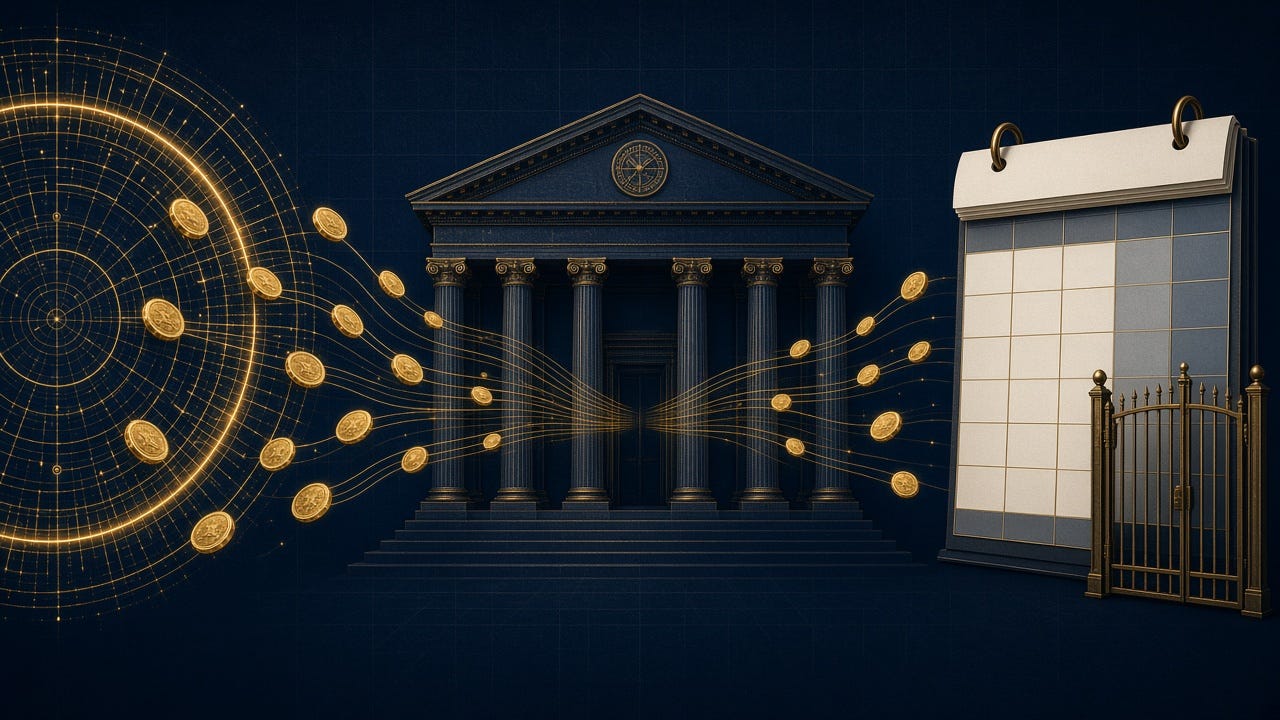
The clearinghouse made 34 US securities, worth roughly $30 trillion in market value, eligible for tokenization. That is what can be converted, not what has been. Tokens can move around the clock, but getting into and out of token form only happens on business days.
Twenty DTC participants, JPMorgan among them, have signed access agreements for a tokenized securities service covering 34 names across large-cap stocks, ETFs, and US Treasuries. The service runs under an SEC no-action letter. Once a security is in token form, it can move between registered wallets around the clock. Converting into or out of token form runs on a business-day schedule.
That gap is the whole story.
What DTCC Actually Turned On This Week
Back in July, we wrote about DTCC’s first live production trades and told you the date that mattered was the full rollout in October, and that the test was whether institutional volume would actually move onto the tokenized rails. This week DTCC launched on schedule: 34 eligible securities, 20 participants with access agreements, and JPMorgan on the list.
Keep the $30 trillion figure in perspective. It is the market value of the securities that are eligible, not the amount that has been tokenized. DTCC’s own FAQ said the launch would support “a select subset of eligible securities based on Participant demand,” with the goal of expanding over time. This is a first set, not a scaled-back one.
The service is live on two networks: Canton and Hyperledger Besu. Stellar, a public blockchain, is the next connection, and as we noted in July, DTCC is targeting the first half of 2027. Securitize also added Stellar as a supported network this same week. Two institutional efforts picking the same public chain in one week is worth watching, though it does not yet prove a trend.
Why the Schedule Matters More Than the Technology
Twenty years on institutional trading desks, ten of them at Morgan Stanley, teach you to read the fine print before the press release. Reporting on the launch puts conversion orders at 2 a.m. to 6 p.m. Eastern, business days only, with DTCC aiming to finish each conversion within 15 minutes. That is a long weekday window. The constraint is the weekend. Tokens already on chain can move between registered wallets on a Saturday, but nobody can create new ones until the next business-day conversion window. A firm that wants to move collateral over the weekend has to convert it beforehand, during an open window. And the transfer is only half of it: the firm on the other side still has to accept the tokenized security as collateral for that particular obligation. This is the same pattern we have watched all year, from SWIFT’s shared ledger in July (provisional finality 24/7, final settlement still tied to central bank hours) to BNY’s tokenized repo trade in October (collateral moves faster, the underlying legal plumbing does not change). DTCC is not building a parallel, permissionless market. It is putting its existing custody ledger into token form while DTC keeps control over who can participate and when securities move into and out of token form.
That is not a criticism. It is the entire reason this launch is credible rather than theoretical. A 20-participant list with JPMorgan on it, running under an SEC no-action letter rather than a hopeful white paper, is a different animal from a startup promising frictionless tokenized equity trading by next quarter. But readers should not mistake “DTCC launched tokenization” for “US securities now trade like crypto.” They do not. The clock DTCC runs on is still largely the clock Wall Street has always run on. What changed is the representation of ownership underneath that clock, not the hours the market keeps.
The open question is what this means for venues building their own tokenized equity markets, OKX-ICE being the obvious current example. DTCC now runs the tokenization layer for the securities those venues want to list. That could make DTCC a competitor. It could just as easily make it a supplier, the place a venue’s tokens come from. Which way it goes will depend on whether DTCC tokens can move onto outside venues, and that is not yet clear.
What This Means for You
Nothing changes for a retail brokerage account this week. This is a custody and clearing layer upgrade among institutions that already hold your shares in street name; you are not getting 24/7 tokenized trading access through this launch. What it does signal is that the infrastructure underneath your broker is quietly being rebuilt, one SEC no-action letter at a time, by the same entity that already clears nearly everything you own. If DTCC’s tokenization layer becomes the default plumbing, the practical effect for retail investors arrives later, as faster settlement and better collateral mobility get passed down through your broker, not as a new app you download.
What’s Next
Two things will tell us whether October’s launch draws sustained use. First, whether the 20 DTC participants signing access agreements translates into measurable conversion order flow in Q4, or whether the list of signers grows while actual usage stays thin. Second, whether DTCC turns its first-half-2027 Stellar target into a firm date. A public blockchain connection from the entity at the center of US securities settlement would be a different milestone from this week’s custody-ledger upgrade.
Presented by The Bridge. Weekly institutional research on blockchain, agentics, and tokenization, written for hedge funds, asset managers, and corporates. Because you read OMNM, the retail edition is yours for $349 (normally $399): thebridgenewsletter.com/signup?ref=omnm. OMNM co-host Douglas Borthwick co-founded The Bridge with Steve Kraus; we may earn a commission.
From the Author
Old Men, New Money co-host Douglas Borthwick has written on this in depth.
Go Deeper — Related Education Modules
Related Guides
Never Miss an Issue
The weekly briefing is free, always.
Join 4,000+ readers getting weekly analysis on the convergence of traditional finance and digital assets — delivered straight to your inbox.