
AI Agents Cannot Keep a Secret. My New Book Is About What Comes Instead.
Subscribe Free. The weekly briefing is free, always.
In the late 1990s I carried a plastic badge that could do three things. It got me through the turnstile at Morgan Stanley every morning. It got me into the Museum of Modern Art for free on a Saturday. And it got me a discount at a gym I did not go to nearly enough.
Years later I understood what I had been carrying. It was three different mechanisms wearing the same coat. The turnstile read a chip that could be cloned with a reader that cost less than lunch. The museum desk looked at a printed logo that anyone could print. The gym never saw the badge at all; I logged into a website with my work email. And when I finally left the firm, nobody at the museum found out. The badge kept working for as long as the laminate held.
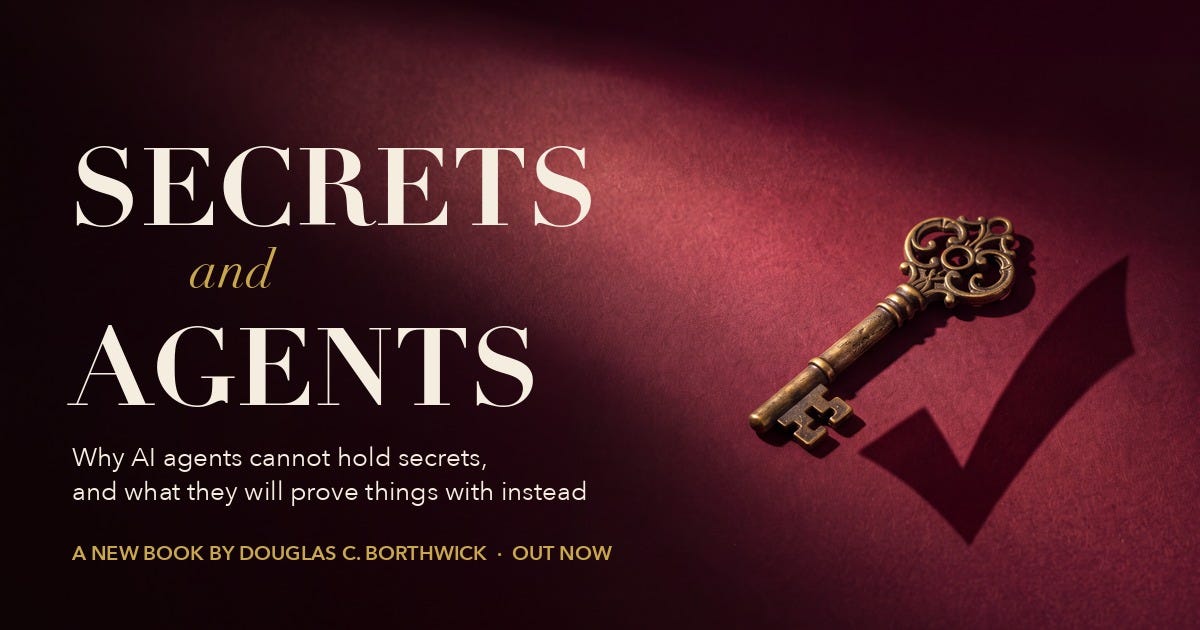
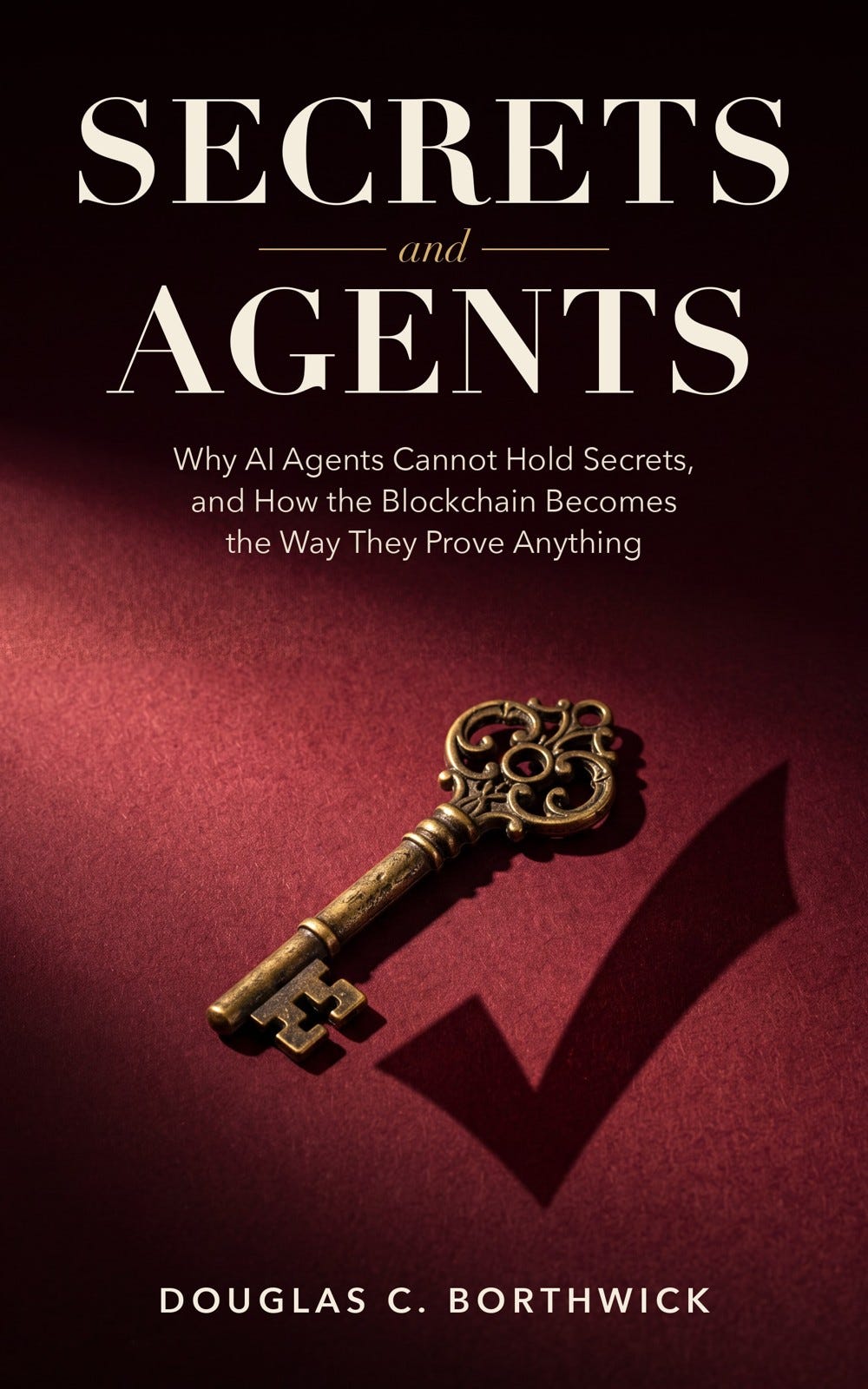
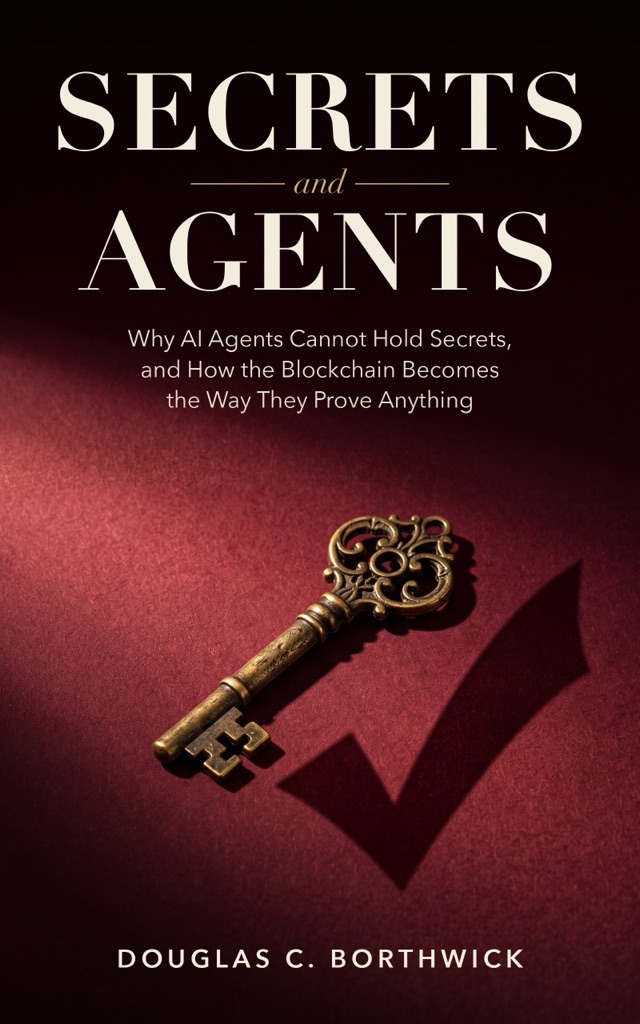
That badge opens my new book, Secrets and Agents: Why AI Agents Cannot Hold Secrets, and How the Blockchain Becomes the Way They Prove Anything. It is out now on Kindle, in paperback, and in hardcover.
Get Secrets and Agents on Amazon
Why I wrote it
Software agents are starting to do our buying, our booking, our comparing, and our asking. Every one of those acts requires proving something. Is this buyer over 21? Does this customer hold shares in the company? Did the owner actually give this agent permission to spend?
Today we prove things with a secret or an identity. A password, a card number, a key. Or: log in, show ID, tell us who you are. To answer a single yes-or-no question, we hand over everything and trust the other side to look at only the part it needs.
Now we are handing that job to software, and an agent is the worst thing you could ever hand a secret to. It reads text from strangers and acts on it. It is copied a thousand times, and every copy has the key. It writes down everything it touches, because that is what logs are for. And it is not a person, so the question “who are you?” does not mean anything when you ask it.
Thirty years in markets taught me one lesson early. Whatever you hand the other side beyond what the trade needs can be lost, and you do not get it back. We are about to hand the keys to something that cannot keep a secret.
The half of the story this list already knows
At the same time, the facts that matter most are moving onto public ledgers: money, shares, memberships, permissions. We have covered that shift here week after week. Wells Fargo launching tokenized deposits. BlackRock bringing a $311 billion cash business onchain. Nasdaq putting $100 million behind tokenized stocks that carry shareholder rights.
Once a fact lives on a ledger anyone can read, you no longer need a secret to prove it. You can check it at the moment it matters.
That is the idea at the center of the book. I call it wallet auth, and I use the phrase the way people use OAuth: as the name of a mechanism, not a brand. It has three steps. Read the state of a wallet. Evaluate a condition against it. Sign a yes or no.
The signed answer is not a secret. You can copy it, log it, or paste it into a chat window. It still says one thing, about one wallet, for a short time, and nobody can turn it into anything else. It carries no balance and no name. It is proof an agent can carry without being able to leak it.
OAuth proves who you are. Wallet auth proves what you hold.
Who it is for
This is not a book about cryptocurrency, and that is deliberate. You do not need to own any to read it, and most of the people in its pages do not. It is written in plain English for the people around you who keep asking why any of this matters: the colleague who runs payments, the friend building with AI agents, the board member who hears “tokenization” and changes the subject.
If you listen to Old Men, New Money®, you already know the ledger half of the story. The book sets it next to the agent half and shows where the two meet.
It is not a brochure either. I run a company that built the mechanism I just described, and I write about it in Part Four, because you would find it strange if I did not. But you can read the first three parts, close the book, and have the whole argument. The idea does not need the product.
Every outside fact carries a source in the notes. Where I imagine a scene that has not happened, I label it. I spent too long on trading floors to confuse what I hope will happen with what has.
What is inside
Part One: Secrets. A short history of the secret, the arrival of the agent, and why an agent cannot hold one.
Part Two: State. The ledger anyone can read, what already lives on it, and why recognition beats replication.
Part Three: The Intersection. Conditions, not credentials. The delegate, the checks that come before an agent pays, an agent buying a share, trust without a score, and privacy as the default.
Part Four: The Frontier. The idea, shipped. What breaks first, and your role.
How it was made
I say this on the first page, so I will say it here too. I used AI to make this book. It is a book about AI agents, and I would have found it strange to write it any other way.
The ideas, the memories, and the arguments are mine. They come from three decades in markets, my earlier books, the essays I have published, and the standards work I have taken part in. A writer used to hand a pile of notes to an editor and get chapters back. I did the same thing, and the editor was AI. It gathered my material, helped draft chapters, checked facts against their sources, and edited for plain language. I directed the work, and I read, cut, corrected, and approved every chapter.
The whole argument of the book is that proof you can check is replacing proof you have to take on trust. It would be odd to ask you to take my word about how it was made.
Get the book
Secrets and Agents is the third book in my Insumer Revolution series, after The Insumer Model and Your Equity in Your Pocket. It stands on its own. You do not need the first two.
It is $4.99 on Kindle (and included with Kindle Unlimited), $14.99 in paperback, and $24.99 in hardcover. All three formats are on one page:
Two small asks. If you read it, please leave an honest review on Amazon. A new book with no reviews is close to invisible, and yours will help more than you would think. And if you know someone who is building with AI agents, or deciding whether to let one near a company card, forward them this email.
The badge in my wallet in the late 1990s was three mechanisms in one coat. The world ahead needs one. Not a better secret. No secret at all.
Douglas
Presented by The Bridge. Weekly institutional research on blockchain, agentics, and tokenization, written for hedge funds, asset managers, and corporates. Because you read OMNM, the retail edition is yours for $349 (normally $399): thebridgenewsletter.com/signup?ref=omnm. OMNM co-host Douglas Borthwick co-founded The Bridge with Steve Kraus; we may earn a commission.
From the Author
Old Men, New Money co-host Douglas Borthwick has written on this in depth.
Go Deeper — Related Education Modules
Related Guides
Never Miss an Issue
The weekly briefing is free, always.
Join 38,000+ professionals getting weekly analysis on the convergence of traditional finance and digital assets — delivered straight to your inbox.