
Wells Fargo Is Launching Tokenized Deposits. The Stablecoin War Just Became a Race Between Trust and Portability.
Subscribe Free. The weekly briefing is free, always.
On August 4, Wells Fargo announced it will launch tokenized deposits for corporate and commercial clients this fall. The rollout starts narrow: a limited U.S. dollar to British pound corridor, offered to select participating clients, running on the bank’s own proprietary blockchain platform. It expands through 2027 to more clients, countries, and currencies.
Wells Fargo’s own language is worth reading carefully. Tokenized deposits, the bank says, will let corporate and commercial clients move, program, and settle funds 24/7/365 “without leaving the regulated, insured banking system.” CFO Mike Santomassimo framed it as moving money between accounts and across borders with greater ease and speed.
That is a launch, not a press release about “exploring” blockchain. But the more interesting number is not this fall’s. It is 2019.
Seven Years From Experiment to Product
In September 2019, Wells Fargo announced it would pilot an internal settlement service called Wells Fargo Digital Cash, running on the bank’s first distributed ledger platform. It had already proven the concept by moving value between the United States and Canada. The stated goal was to expand to multicurrency transfers across the entire global branch network.
Seven years ago, Wells Fargo was moving digital cash between its own entities. This fall, it puts tokenized deposits in front of corporate customers.
That gap is the real lesson. I have watched banks announce blockchain projects for a decade, and most die in committee. The ones that survive do not move fast. They move from internal experiment, to internal utility, to a narrow customer pilot, to a product — and it takes the better part of a decade. Anyone who told you in 2019 that bank blockchain was vaporware was wrong. Anyone who told you it was imminent was also wrong.
What a Tokenized Deposit Actually Is
Here is where most coverage gets sloppy, and where the distinction matters.
A tokenized deposit is a claim on Wells Fargo. It is commercial bank money. The token changes how the claim can move and be programmed; it does not turn commercial bank money into central bank money. Wells Fargo is running this on its own proprietary blockchain platform with in-house custodial wallets. The deposit remains a Wells Fargo liability throughout.
The insurance framing needs the same discipline. Wells Fargo says its tokenized deposits will carry “the same regulatory protections and deposit insurance eligibility” as its existing deposit products. Eligibility is the operative word. Standard FDIC limits still apply — generally $250,000 per depositor, per insured bank, per ownership category. A corporate treasury balance of $30 million does not become $30 million of insured money because it has been tokenized.
So the pitch is not “FDIC insured.” The pitch is broader and, honestly, more powerful than that:
An existing deposit claim, at an existing bank relationship, under existing regulatory treatment, inside an existing compliance framework — that now settles 24/7 and can be programmed.
Nothing new to onboard. No new counterparty to diligence. No new risk memo. That is what a corporate treasurer is actually buying.
Why This Particular Launch Is Credible
First, the regulatory path is clear. On August 4 — the same day as the Wells Fargo announcement — the FDIC approved the deposit insurance application for Augustus National Bank, a newly chartered national bank in Dallas built around digital asset companies, with plans to issue a stablecoin through a subsidiary if approved under the GENIUS Act. On August 12, the SEC’s Division of Investment Management issued a no-action letter allowing Franklin Templeton’s registered funds to hold shares of its onchain U.S. government money fund (FOBXX, known as BENJI) for cash management, relieving them of certain physical-custody provisions of the 1940 Act. The structure works because Franklin Templeton Investor Services retains control of the Stellar wallets and the private keys, as transfer agent — a blended onchain and off-chain arrangement the staff treated as close enough to existing book-entry practice, subject to conditions. These are not white papers. These are live approvals with named compliance scaffolding.
Second, the infrastructure already scales. Broadridge’s Distributed Ledger Repo platform processed $8.0 trillion in repo transactions in July, averaging $365 billion a day — a 28% increase in the daily average year over year. Wall Street’s post-trade plumbing is already moving this way, at volumes that dwarf anything in crypto, and it is surviving operational scrutiny from the institutions that move the most money on earth.
Third, the client demand is being priced. Mastercard agreed to acquire stablecoin infrastructure firm BVNK for up to $1.8 billion, explicitly to support use cases spanning stablecoins, tokenized deposits, and tokenized assets. That is a payments network paying nine figures for the connective tissue between fiat rails and on-chain money — because it has seen the client flow data and concluded both forms are going to matter.
The Real Contest Is Not Banks Versus Stablecoins
The tempting story here is that banks are building the same product stablecoins offer, and will win because they are banks. That story is wrong, and getting it wrong costs you the actual insight.
Tokenized deposits and stablecoins overlap functionally. They are not the same instrument. A tokenized deposit is a liability of one bank, operating inside the banking system and, at least initially, inside a controlled network. A stablecoin is designed as a portable claim that circulates across wallets, exchanges, applications, and public blockchains, without asking anyone’s permission.
Banks already own the trust. Stablecoins already own the distribution and the composability. Which means the question is not:
Can Wells Fargo tokenize a dollar?
Of course it can. It has been able to since 2019. The question is:
Can banks make tokenized deposits as portable as stablecoins without surrendering the institutional controls that make tokenized deposits worth using in the first place?
That is a genuinely hard problem, and the industry knows it. On June 5, The Clearing House unveiled a bank-led on-chain money initiative with JPMorgan, Bank of America, Citi, and Wells Fargo, joined by more than a dozen others including BNY, HSBC, PNC, Truist, and U.S. Bank — consolidating separate bank blockchain projects into a shared network, reported to be targeting the first half of 2027. The stated scope is on-chain clearing and settlement of tokenized deposits between participating banks: programmable treasury, real-time liquidity, cross-border payments, agentic commerce, digital-asset settlement. The whole point is that a Wells Fargo token should eventually settle against a Citi or JPMorgan token under common rules — something a proprietary platform cannot do alone. Wells Fargo has said its own inter-chain connectivity technology is coming in future offerings.
Note what that admits. Wells Fargo is shipping a proprietary platform this fall and helping build the shared network that makes the proprietary platform less proprietary. Both, at once. That is what a portability problem looks like from the inside.
Nobody Is Actually Choosing Sides
The other thing the “banks kill stablecoins” story misses: the banks are not picking one.
Standard Chartered-backed Anchorpoint began the first phase of its Hong Kong dollar stablecoin, HKDAP, on August 12 — institutional distributors and professional investors first, on Ethereum mainnet, under Hong Kong’s new licensing regime, with retail access targeted as early as the end of this year. Wells Fargo’s own annual report describes both stablecoin and tokenization initiatives. Augustus National Bank got its FDIC approval while planning a stablecoin subsidiary.
The emerging posture is not banks versus stablecoins. It is banks intending to own both forms of programmable money, and using whichever one fits the flow.
What That Means for Tether and Circle
USDT alone is roughly $183 billion in circulation, in a stablecoin market that has grown past a quarter-trillion dollars. Circle is public on the NYSE with licenses in multiple jurisdictions. Both have spent years building distribution, custody, and acceptance networks that no bank consortium has replicated.
The risk is not that stablecoins disappear. Stablecoins hold real structural advantages that tokenized deposits will struggle to match: cross-border dollar access, crypto settlement, public-chain composability, exchange collateral, emerging-market dollarization, and permissionless 24/7 transfer to anyone with a wallet.
The risk is narrower and more specific. It is that regulated tokenized deposits recapture the highest-value corporate treasury flows — the profitable, sticky, compliance-sensitive volume — while stablecoins remain dominant wherever portability, public-chain liquidity, and global dollar access matter more than an existing banking relationship.
Wells Fargo does not need to out-market Tether. It needs to offer a product a CFO and a compliance officer can approve without a forty-page risk memo. For a large slice of corporate flow, that is the whole competition.
What to Watch
Watch for client names. Wells Fargo said “select participating corporate and commercial clients.” If the fall rollout includes Fortune 500 treasurers or multinationals with real FX hedging complexity, this is a product. If it is three partners testing for six months, it is still the 2019 pilot wearing a better suit.
Watch for interoperability that actually ships. The value of tokenized deposits multiplies if they can move across bank networks the way stablecoins move across blockchains. The Clearing House network is the test, and the reported target is the first half of 2027 — which means the next twelve months are about whether the participating banks can agree on common rules, not about whether any one of them can mint a token. Watch the same question in collateral, where the progress is real but uneven. Société Générale said in May it would accept tokenized collateral as margin for its Prime Services clients on Canton, and would act as a repo counterparty there. Marex went further in June and actually completed an on-chain repo. And on July 15, DTCC processed its first live production trades in tokenized DTC-custodied assets — stocks, ETFs, and Treasuries — with roughly forty institutions including JPMorgan, Goldman Sachs, and BlackRock, running a hybrid architecture across Canton and Hyperledger Besu, with a broader tokenization service targeted for October pending regulatory clearance.
Stablecoins spent a decade making dollars move like information. Banks spent that decade watching, and building quietly. Now the deposits are going on programmable rails — and this will not be settled by who can tokenize a dollar. It will be settled by whose dollar can go everywhere.
Presented by The Bridge. Weekly institutional research on blockchain, agentics, and tokenization, written for hedge funds, asset managers, and corporates. Because you read OMNM, the retail edition is yours for $349 (normally $399): thebridgenewsletter.com/signup?ref=omnm. OMNM co-host Douglas Borthwick co-founded The Bridge with Steve Kraus; we may earn a commission.
From the Author
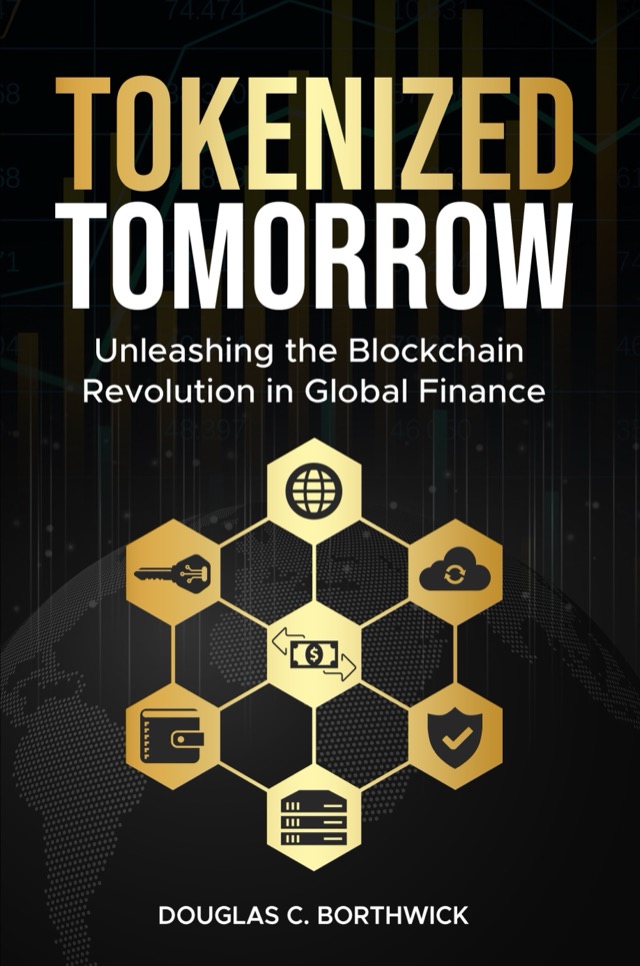
Old Men, New Money co-host Douglas Borthwick has written on this in depth.
Go Deeper — Related Education Modules
Related Guides
Never Miss an Issue
The weekly briefing is free, always.
Join 38,000+ professionals getting weekly analysis on the convergence of traditional finance and digital assets — delivered straight to your inbox.