
THE CREDENTIAL WE NEVER BUILT
Subscribe Free — 100% Free, Always.
I have been sitting on this for a while. Felt like it was time to say it.
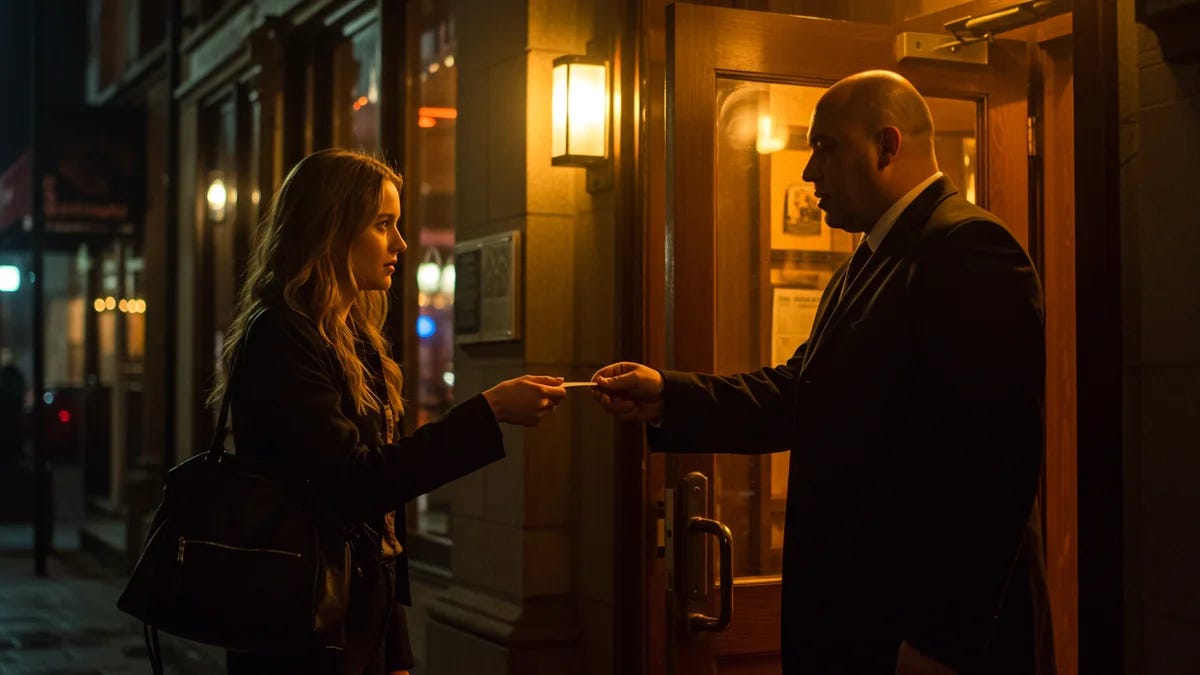
A young woman walks up to a doorman. She wants to get into the bar. He needs to know one thing: is she over 21? Instead, she hands him her driver’s license. Her full name. Her home address. Her photograph. A complete record of who she is, handed to a stranger, to answer a single yes-or-no question.
A student wants the campus discount. The vendor needs to know one thing: is she enrolled? Instead, she hands over her transcript, her GPA, her enrollment dates, her student ID. Her entire academic record, handed to a cashier, to answer a single yes-or-no question.
A candidate applies for a job. The employer needs to know they can do the work. Instead, they hand over every job they have ever had, every gap in their history, every address they have ever lived at. Their whole life, handed to a hiring manager, to answer a single yes-or-no question.
This is not history. This is Tuesday.
You upload your passport to a crypto exchange just to prove who you are. You send bank statements to a lender just to prove you have money. You hand your resume to a recruiter just to prove you have done the work. Every system asks a different question. Every system takes everything. And none of them talk to each other.
We built a world on oversharing by necessity. Not because it was right. Not because it was efficient. Because there was no other way. The only way to prove one thing was to hand over everything and let the other side sort through it.
And all of that extra information, the stuff they never needed and should never have kept, that is what gets stolen. That is what gets leaked. That is what gets sold. The breach is never the thing they needed. It is everything else you handed over to prove it.
A Wallet Tells Your Story
I spent thirty years on Wall Street. Morgan Stanley. Merrill Lynch. Standard Chartered. And the one thing I watched over and over again was ownership opening doors that most people never even knew existed. The shareholder got the vote. The bondholder got the protection. The institutional investor got the call before anyone else. Ownership was always the real credential. The system just kept it quiet.
I was part of the team that put together the first SEC-registered security token. And sitting in that room, I saw something most people missed. They were focused on the capital raise. I was watching something else: for the first time, proof of ownership was moving onto a public ledger. Readable by anyone. Instantly. No broker, no transfer agent, no clearing house needed.
A wallet is just a record of what you own. Except no one can change it and no one can take it away.
But it is also something more than that. It is a biography. The dust from a token that did not make it. The remnants of a trade you got right. An NFT you picked up during a moment you still remember. Things that went well and things that did not. Projects you believed in and ones you forgot you even owned. All of it still there, unchanged, yours. The wins. The losses. The whole story.
No bank statement tells that story. No credit score captures it. But over time, a wallet becomes a fingerprint that is genuinely unlike anyone else’s. Not because someone is reading it. Because the specific combination of what you hold and how much is yours alone.
The Credential We Never Built
The internet solved identity twenty years ago. OAuth answers one question: who are you? Log in with Google. Log in with Apple. Done.
Nobody built the layer for the harder question: what do you hold?
Any combination of conditions, drawn from hundreds of millions of tokens and NFTs across dozens of blockchains, specifying not just what you hold but how much, can now be turned into a single cryptographic unlock. A lock that any merchant, any business, any AI agent in the world can set. A key that only the right wallet can open.
When that unlock fires, the other side sees exactly one thing: that you held the right combination. Not your history. Not your balance. Not your losses or your gains or the dust from the project that did not make it. Not your name or your address or your photo.
Just the door, opening.
You keep your story. They get their answer. Nothing else moves.
So We Built It
The question I walked out of that room with was simple. If you can prove what someone owns in seconds, privately, without them handing over their life, why isn’t that proof being used for anything?
The answer was that nobody had built it.
Once you can prove exactly what matters, and nothing else, there is no reason to keep doing it the old way.
So we did.
It is in production today.
And once you see it, it is very hard to go back.
The infrastructure is live at insumermodel.com
Go Deeper — Related Education Modules
Never Miss an Issue
100% Free — Always.
Join 38,000+ professionals getting weekly analysis on the convergence of traditional finance and digital assets — delivered straight to your inbox.